
General Guideline for Behavioral Interview
In this chapter, we will first introduce three general guidelines for behavioral interviews. We also identified eight categories of common behavioral questions and go deep into each one of them in the next eight chapters.

For each topic, we will show a few most common questions, analyze what the interviews are really looking for, share best practices and common pitfalls. In some cases, we will also list some question variations.
Use the STAR framework
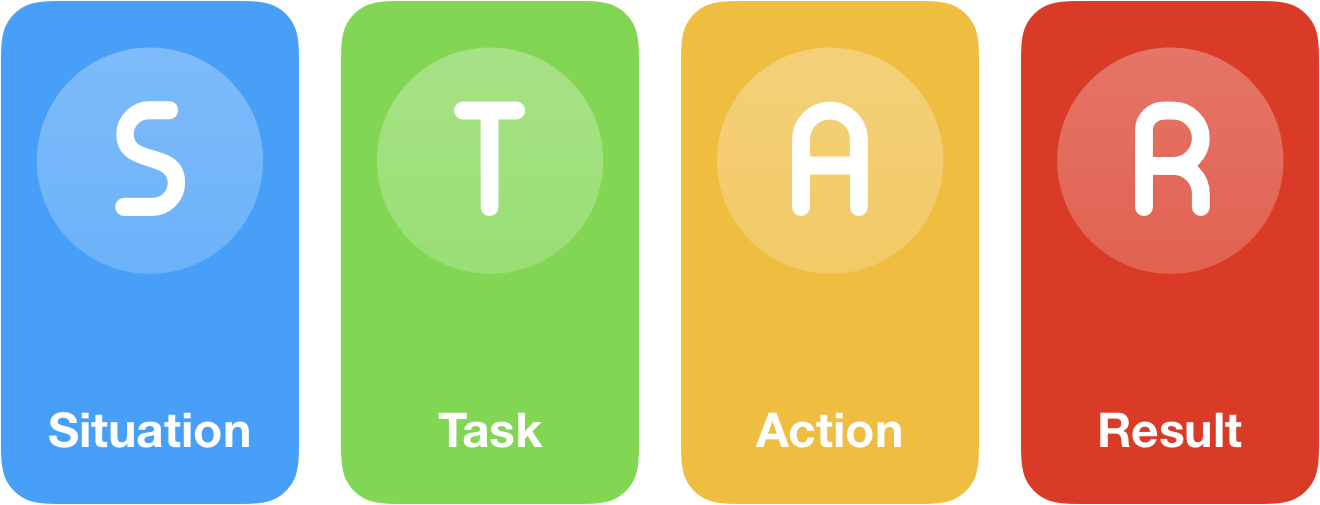
The STAR method is a gold standard in answering behavioral-based interview question by discussing the specific situation, task, action, and result of the situation you are describing.
-
Situation: Describe the situation that you were in when you needed to accomplish. It can be from your current job, previous job or from any relevant experience such as volunteer work or college clubs.
-
Task: What goal were you working toward? Describe the challenge and what needs to be done to get a positive output?
-
Action: Elaborate the measures you took to address the situation with an appropriate amount of detail. Describe the precise steps you took and the contribution. Talk about yourself rather than the team.
-
Result: Describe the outcome of your actions in a quantifiable way. Communicate multiple positive results. If the answers have a negative outcome, they should highlight your resilience or adaptability.
Prepare. Prepare. Prepare.
The most common mistake in an interview is that people come unprepared. Sometimes, a candidate does not even have a reasonable understanding of what the company does, or is unable to explain what she has done in the past concisely. This can be addressed by spending some time to prepare.

-
Research the company and your interviewers. It will show that you have done your homework thoroughly. Only after considerable research, you can ask questions with great insights and have a meaningful conversation with the interviewers.
-
Get a list of 10 interesting questions. Asking the right questions is not only a great way to get the right information for you to assess the company and the opportunity, but also a great way to demonstrate your insights and unique perspective.
-
Practice. Practice. Practice. You are almost certain to encounter certain questions, for example, a quick overview of your recent project, your top strengths, your development areas, why you apply to this role. You should have very crisp answers to these questions.
Communicate
No matter if you are in engineering, sales, or marketing, communication plays a critical role for you to be effective at work. Thus, the interviewers will try their best to get a read on your articulation and communication style.

-
Explain your solution. The interviewers definitely care whether they have the right answer to the technical questions, but they care even more about your thinking process. Please make sure to explain the thought process why you are approaching the problems in this way.
-
Be Succinct. Be direct with your answers, especially for your past experience. People care less about all the glory background. Please just share enough so that the interviewer can truly understand what you try to convey. Of course, overly terse is bad too since the interview may not have enough context to appreciate the complexity and significance of your past successes.
-
Listening. Demonstrate active listening skills, ask clarification questions if needed. Do not rush to answer a question if the interviewer is still trying to explain. By listening, you can get a better sense of what your interviewers are interested in so that you can tailor your response including selecting the right examples to resonate better with the interviewer. Of course, the last thing you want to do is to argue with an interviewer.