
Motivation and Values
We, human beings, are driven by what we value. It leads us to be more passionate about some jobs than others. As an individual, you want to find the jobs that you are passionate about. At the same time, the employers will also prioritize finding someone who is truly passionate about the job. One effective way to assess whether the job function matches with your passion is to have a deeper understanding of your motivation and values. Interviewers, especially the managers, use this question to assess if the tasks done at the job intrinsically motivate you. They are looking for signs to determine your cultural fit in the team and company, and the likelihood to stay in the company.
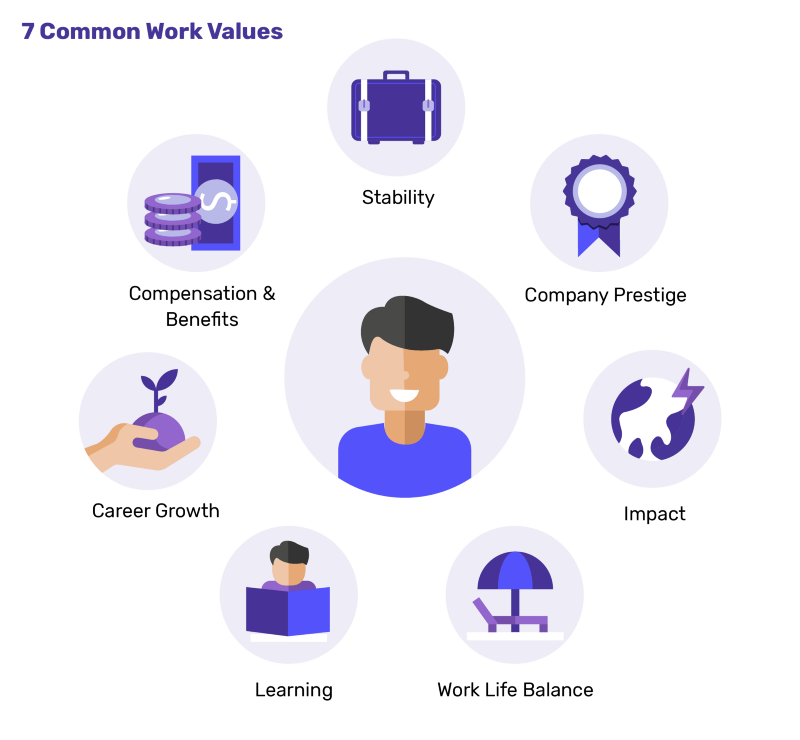
The table above shows 7 common work values that Leap.ai has summarized. When deciding which companies are right for you, you should definitely be honest with yourself. However, in an interview, the interviewers will probably appreciate answers related to impact, learning, career growth, and then work-life balance, stability, or compensation.
Why are you interested in this role?

What is the interviewer looking for: The interviewer is trying to understand what drives you, how your values align with the company’s, what are the chances to accept the offer if offered, and what is the chance you will do well in this company.
Best practice to answer: Choose an answer where your goals align with the position and also show the value-add to the company. It should be tailored according to the specific job position. Show how your actions and your plans are in harmony. Your knowledge, enthusiasm, and efforts will go a long way in answering this question. A good way to answer this question is to illustrate how well this job aligns with your career goals.
Common pitfalls:
-
Having a generic answer for all interviews. You need to go deeper, show what you have learned about the company, why you like it and why you will be a good fit.
-
Emphasize too much on work-life balance and risk. There is nothing wrong about joining a more stable company due to personal and family needs, but it should be a secondary reason, not the primary reasons, at least in the interview :) In your answer, you should focus on your primary reasons: impact, learning, career growth.
Question variations:
- Why do you want to work here?
- How is this role in alignment with your career goals?
- What do you want to get in your next job?
What is the interviewer looking for: The interviewer is looking at your thought process about your holistic development, which is often correlated to the kind of leader you want to be. It implies the leadership dimension you value and appreciate. The interviewer will then assess whether this is a good fit for the team.
Best practice to answer: If you have a clear role model, that is great. Please give three reasons about why this person is your role model. It is also perfectly fine to have an abstract role model. Please list three dimensions of the abstract figure. This shows the kind of personality and traits that you want to embody and inspire to be.
Common pitfalls:
- Not substantiating your role model with the traits you want to embody.
Question variations:

- Who is your favorite athlete?
- Who is your favorite CEO?
- Who is your dream manager or teammate?
What drags you out of bed?
What is the interviewer looking for: The interviewer is looking for the motivational factors that keep you going. The interviewer will try to aggregate your answers, your strengths, and your background to form an overall view of you and assess how well you will fit in the team’s needs.
Best practice to answer: Talk about what you care most deeply, why it matters to you, and how you have committed 100% of your energy to do things you care, no matter if it is technology advancement, business success, amazing user experience, or learning new things to expedite your growth.
It is ok to joke it is the kids and the alarm that get you up, but please do not stop there :) The interviewers want to know more about what drives you.

Common pitfalls:
-
The answer is completely unrelated to the job. Yes, you have your passion, but how will it contribute to your success on the job? Will it become a distraction from your work performance?
-
Answer targeted entirely towards job description. It is a good idea to connect your answer to the job, but if it is overdone, the interviewer will know you are not being genuine and trying too hard to get the job.
-
Broad and generic answers that do not seem to be very sincere and genuine. If you are unable to communicate passionately, the interviewer will think either you are not able to communicate well or you are not giving a genuine response.
Question variations:
- What keeps you going?
- If you have achieved financial freedom today, what will you be doing?
- What is your dream job?
Do you have any questions for me?
What is the interviewer looking for: On one side, the interviewer is giving you an opportunity to ask questions so that you have a better understanding of the company. On the other hand, the interviewer is also going to form her opinion about how excited you are with the company, based on the questions you have asked.
Best practice to answer: You should think about two things here. One is to ask questions that you still have about the company and the role. Just as the company is interviewing you, you are interviewing it as well. The other is to ask questions that demonstrate your passion, knowledge and thought leadership in this space.
If you do not have questions or your questions are very superficial, it will be a clear indicator that you are not highly interested in the role, or you are not a curious person. Both cases are bad signs to an interviewer.
Below are some sample questions that can help you get started:
- I read the news that xxx is also starting a similar service. What is your take on their move?
- What big trends do you see in xxx space in the next 3 years?
- What 3-5 words will you use to describe the team’s culture?
- What are the biggest challenges that someone in this role will face?
- What does your day look like?
- How satisfied is the team with their career development?
Common pitfalls:
-
No questions: this shows that you have not researched the company and the role properly, or you are not interested.
-
Asking very generic questions that can be answered using Google search. This is a very precious moment for you to get meaningful information about the role. Please do not waste it.
-
Ask too detail questions, such as benefits. This is not the time. You have plenty of time to ask about benefits after you get the offer.
Question variations:
- This is one question that everyone will ask :)