LeetCode Problem Link
https://leetcode.com/problems/rotate-array
Intuition
- I restrict myself to think only for the space complexity of \(O(1)\).
- then, the problem becomes to be medium level.
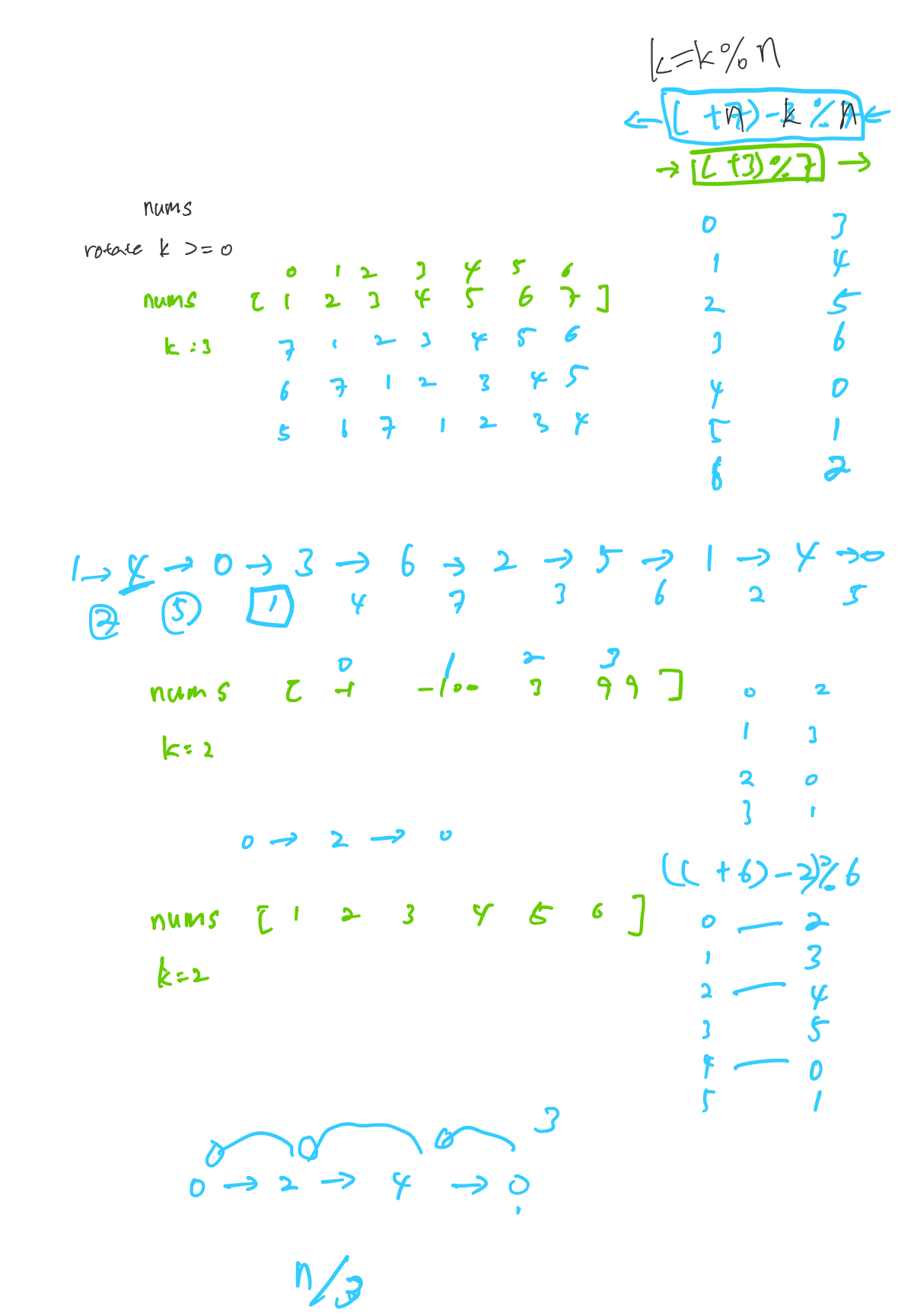
- It shows jumping indices to move the value to the next position.
Approach
- check whether I could jump to the previous position then, I can set aside the first value and shift the previous value to the current position and make the previous position to be the current position.
size_t prev(const size_t cur, const size_t k, const size_t n) noexcept { const size_t j = k % n; return ((cur+n)-j) % n; } size_t next(const size_t cur, const size_t k, const size_t n) noexcept { return (cur+k) % n; } void rotate(vector<int>& nums, int k) { const size_t n = size(nums); k = k % n if (k == 0) return; // [1], 0 if (n == 1) return; // [1], 3 int first = nums[0]; size_t cur = 0; for(size_t i=0; i<n; ++i) { const size_t prv = prev(cur, k, n); nums[cur] = nums[prv]; cur = prv; } // the last move from the value I set aside at the beginning nums[next(0, k, n)] = first; } - but, there are corner cases: ‘nums=[-1, -100, 3, 99], k=2’ / ‘nums=[1,2,3,4,5,6], k=2’
- This method requires traversing only the elements within a single cycle, rather than traversing all elements, thus necessitating movement between cycles.
- these cycles are all the same size, and the number of cycles is the result of dividing the size of the
numsarray by the size of one cycle. the cycle size is the GCD (n, k).size_t start = 0; int val = nums[start]; size_t cur = start; for(size_t i=0; i<n; ++i) { const size_t prv = prev(cur, k, n); if (prv == start) { // the last move from the value I set aside at the beginning nums[cur] = val; start++; val = nums[start]; cur = start; } else { nums[cur] = nums[prv]; cur = prv; } } - the code is “write-only code.” poor readability.
- Cognitive Load (인지 부하): prev, next, start(?), cur… 인덱스 계산이 너무 복잡합니다. 코드가 복잡하면 버그가 숨을 곳이 많아집니다.
- Modulo Overhead: prev 함수 내부의 Modulo(%) 연산은 CPU 사이클을 많이 먹습니다. 루프마다 이를 수행하는 것은 비효율적입니다.
- Cache Locality: 메모리를 띄엄띄엄 읽어옵니다(nums[prv]). 배열의 크기가 커질수록 Cache Miss가 발생하여 성능이 저하됩니다.
Complexity
-
Time complexity: \(O(n)\)
-
Space complexity: \(O(1)\)
Code
class Solution {
public:
    void rotate(vector<int>& nums, int k) {
        const size_t n = size(nums);
        k = k % n;  // Key Logic!!
        if (k == 0) return;
        if (n == 1) return;
#if 0
#if 0
        std::rotate(begin(nums), end(nums)-(k%size(nums)), end(nums));
#else
        std::reverse(begin(nums), end(nums));
        std::reverse(begin(nums), begin(nums)+k);
        std::reverse(begin(nums)+k, end(nums));
#endif
#endif
#if 1
        size_t cycles = std::gcd(n, k);
        for (size_t start=0; start<cycles; ++start) {
            int val = nums[start];
            size_t cur = start;
            do {
                const size_t nxt = (cur + k) % n;
                int tmp = nums[nxt];
                nums[nxt] = val;
                cur = nxt;
                val = tmp;
            } while (cur != start);
        }
#endif
#if 0
        size_t start = 0;
        size_t cnt = 0;
        while (cnt<n) {
            int val = nums[start];
            size_t cur = start;
            do {
                const size_t nxt = (cur + k) % n;
                int tmp = nums[nxt];
                nums[nxt] = val;
                cur = nxt;
                val = tmp;
                ++cnt;  // cycle decomposition
            } while (cur != start);
            start++;
        }
#endif
#if 0
        size_t start = 0;
        int val = nums[start];
        size_t cur = start;
        for (size_t cnt=0; cnt < n; ++cnt) {
            const size_t prv = ((cur+n)-k) % n;
            if (prv == start) {
                nums[cur] = val;
                start++;
                val = nums[start];
                cur = start;
            }
            else {
                nums[cur] = nums[prv];
                cur = prv;
            }
        }
#endif
    }
};
GitHub
- ToDo: rotate-array