LeetCode Problem Link
https://leetcode.com/problems/valid-palindrome
Intuition
- change all the letters to lower cases
std::transform(begin(s), end(s), begin(s), [](uint8_t ch) { return std::tolower(ch); }); - skip all the non-alphanumeric characters
int cnt=0; for (auto ch : s) { if (std::isalnum(ch)) { s[cnt++] = ch; } } - check whether there is stdlib for this but
all_ofis just for checking not for changestd::all_of(begin(s), end(s), [&s, &cnt](uint8_t ch) { if (std::isalnum(ch)) { s[cnt++] = ch; } return true; });
Approach
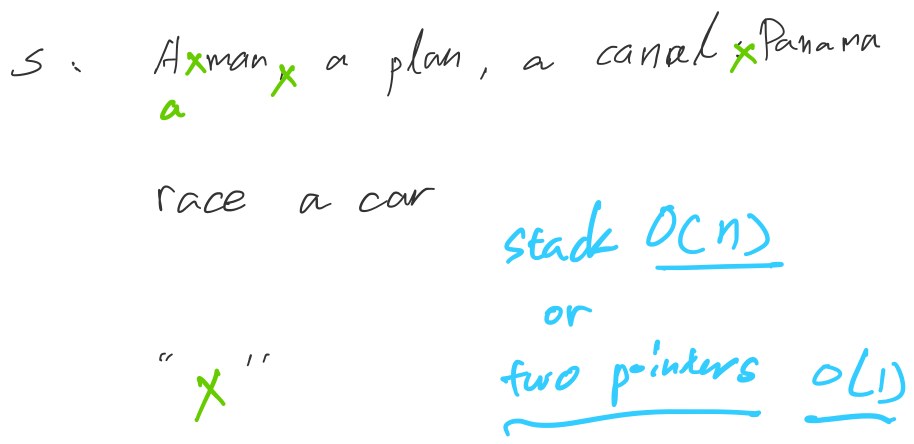
- use two pointers rather than stack
if (cnt <= 1) return true; size_t head=0; size_t tail=cnt-1; for (;head<tail; ++head, --tail) { if (s[head] != s[tail]) { return false; } } return true; - it works, then let’s remove redundant copies using cyclic decomposition
bool isPalindrome(string s) { int head = 0; int tail = static_cast<int>(s.length())-1; for(;head<tail;++head,--tail) { while(head<tail&& !std::isalnum(s[head])){ ++head; } while(head<tail&& !std::isalnum(s[tail])){ --tail; } if (std::tolower(s[head])!= std::tolower(s[tail])) { return false; } } return true; } - lastly, improve readability with one while loop and apply string_view
Complexity
-
Time complexity: \(O(n)\)
-
Space complexity: \(O(1)\)
Code
class Solution {
public:
    bool isPalindrome(string_view s) {
        int head = 0;
        int tail = static_cast<int>(s.length())-1;
        while (head<tail) {
            if(!std::isalnum(s[head])) {
                ++head;
                continue;
            }
            if(!std::isalnum(s[tail])) {
                --tail;
                continue;
            }
            if (std::tolower(s[head++])!= std::tolower(s[tail--])) {
                return false;
            }
        }
        return true;
    }
};
GitHub
- ToDo: valid-palindrome