LeetCode Problem Link
https://leetcode.com/problems/sliding-window-maximum
Intuition
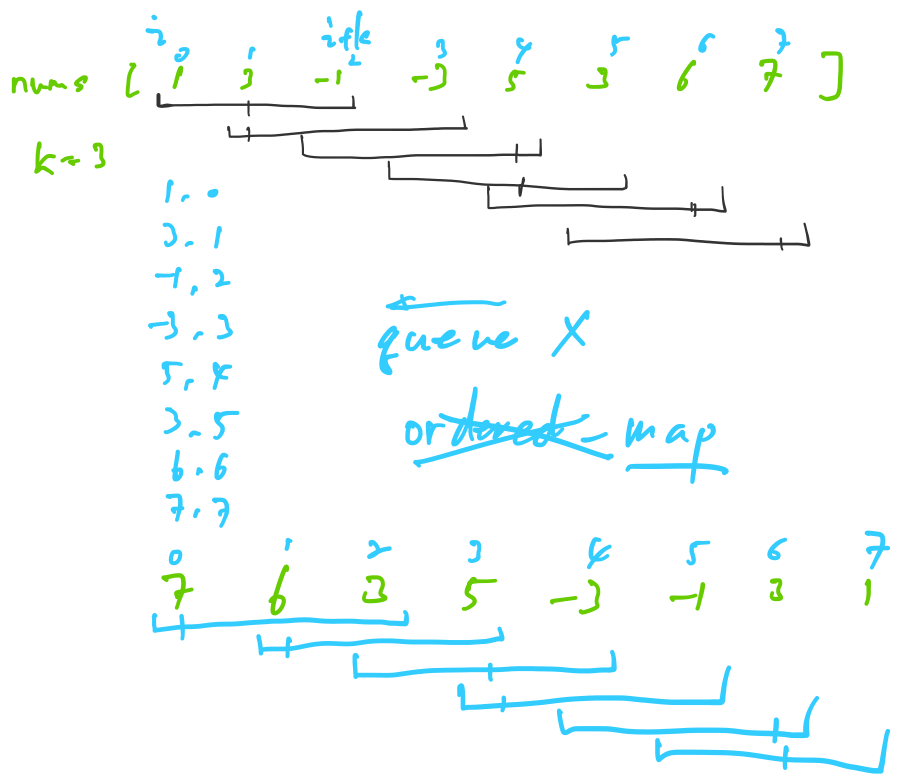
- at first, thought about using a map, but it was too expensive to insert and delete (\(O(\log k)\))
- also, the key value can be duplicated and invalid indices should be removed as the window moves
Approach
- to remove invalid items out of window, let’s use queue
- also, we need to remove previous items that is smaller than new item
- a two-way modifiable queue is required for keeping only
kitems decreasing order => Monotonic Queuetypedef std::pair<int, size_t> is; std::deque<is> mon_q; for (size_t i=0; i<n; ++i) { while (!mon_q.empty() && mon_q.back().first <= nums[i]) { mon_q.pop_back(); } mon_q.emplace_back(std::make_pair(nums[i], i)); if (static_cast<int32_t>(mon_q.front().second) <= static_cast<int32_t>(i)-k) { mon_q.pop_front(); } if (i>=k-1) result.push_back(mon_q.front().first); } - if we don’t sort based on the values, then we don’t need the value itself => use nums[] to check the value
- we need signed values to check > or <
- for checking == or !=, we can use unsigned values
- in the initial interval where
i < k,i - kunderflows and becomes a large positive integer => guard clause added
Complexity
-
Time complexity: \(O(n)\)
-
Space complexity: \(O(k)\)
Code
    vector<int> maxSlidingWindow(vector<int>& nums, int k) {
        vector<int> result;
        if (k<=0) return result;
        const size_t n = size(nums);
        if (n==0) return result;
        std::deque<size_t> deq;
        for (size_t i=0; i<n; ++i) {
            while(!deq.empty() && nums[deq.back()] <= nums[i]) {
                deq.pop_back();
            }
            deq.emplace_back(i);
            if (i>k && deq.front() == i-k) {    // gaurd clause added
                deq.pop_front();
            }
            if (i>=k-1) {
                result.push_back(nums[deq.front()]);
            }
        }
        return result;
    }
GitHub
- ToDo: sliding-window-maximum