 Cool Wind on Study
Integrated Daily Battle Plan - Day3
2025-12-21 11:34
Tags: [[_Integrated Daily Battle Plan]], [[study]]
Low-Latency C++ Optimization & Exception Safety
1. The noexcept Performance Contract
Core Doctrine: noexcept is not just documentation; it is an architectural decision that affects binary size (removing .eh_frame overhead) and runtime path selection (Move vs. Copy).
A. The “Vector Reallocation” Trap
std::vector requires Strong Exception Guarantee during resizing.
- Scenario: Vector runs out of capacity -> Allocates new block -> Moves elements.
-
The Trap: If
Move Constructoris NOTnoexcept, the compiler forces a COPY to ensure data isn’t lost if a move throws halfway. This destroys performance.
Drill Snippet: The Optimized Sensor Node
class SensorNode {
    int* data;
    size_t size;

public:
    // [BAD] Compiler assumes this might throw -> std::vector uses COPY.
    // SensorNode(SensorNode&& other) { ... }

    // [GOOD] Explicit contract -> std::vector uses MOVE (Pointer Swap).
    SensorNode(SensorNode&& other) noexcept
        : data(other.data), size(other.size) {
        other.data = nullptr;
        other.size = 0;
    }

    // [MANDATORY] Destructors must never throw.
    ~SensorNode() noexcept {
        delete[] data; // Internal try-catch if logic is complex
    }
};
B. Conditional Noexcept (The Wrapper Pattern)
Rule: When writing templates or wrappers, do not blindly add noexcept. Use the “Conditional Noexcept” idiom to propagate the safety guarantee of the underlying type.
template <typename T>
void safe_swap(T& a, T& b) noexcept(noexcept(a.swap(b))) {
    // If a.swap(b) is noexcept, this function is noexcept.
    // If a.swap(b) throws, this function throws (avoiding std::terminate crash).
    a.swap(b);
}
C. std::move_if_noexcept Strategy
Use Case: Critical Transactional Logic where Data Safety > Performance.
void transfer_ownership(SensorNode& source, std::vector<SensorNode>& dest) {
    // 1. If Move Ctor is noexcept: Casts to rvalue (Fast Move).
    // 2. If Move Ctor throws: Casts to const lvalue (Safe Copy).
    dest.push_back(std::move_if_noexcept(source));
}
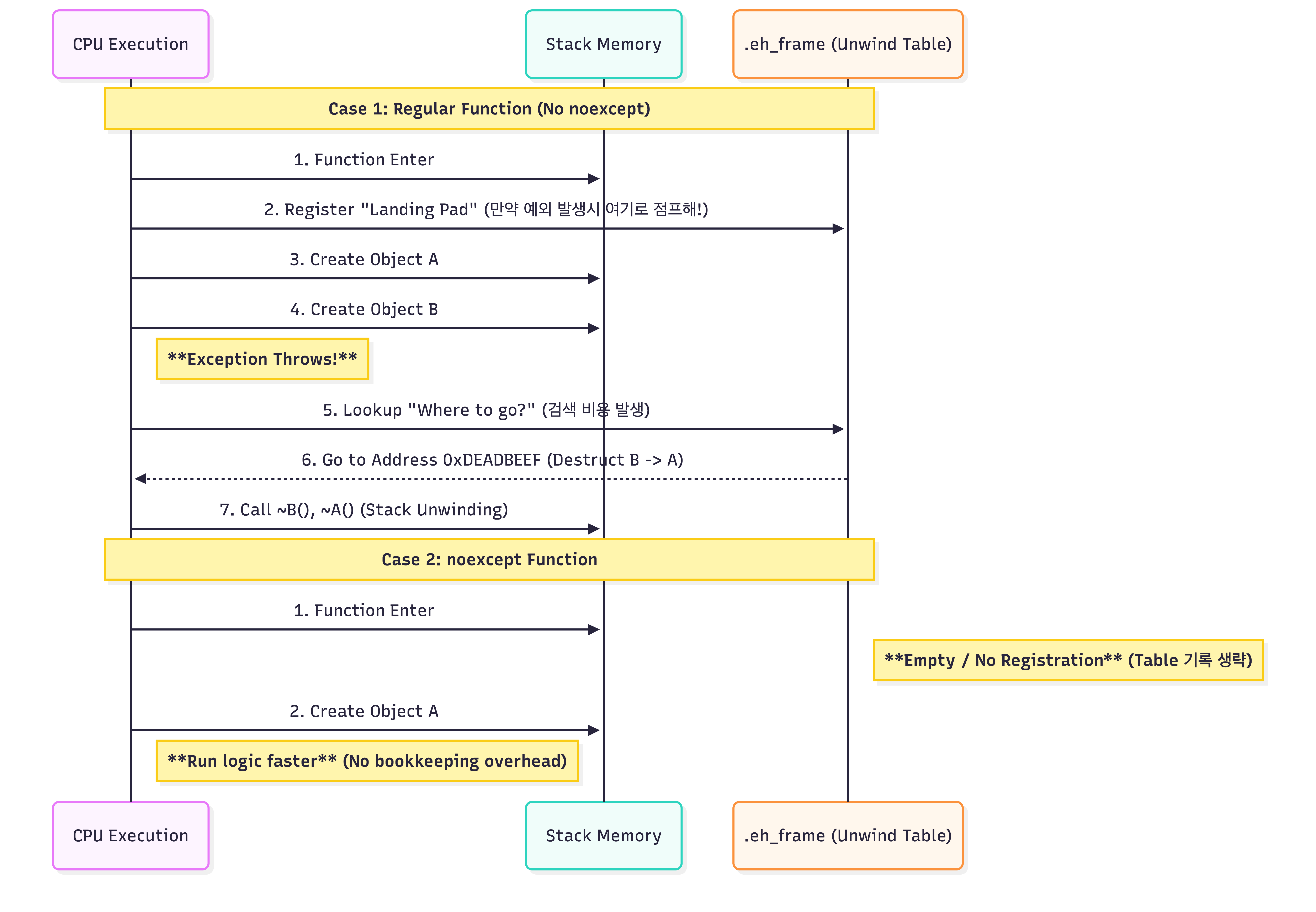
2. Low-Level Mechanics: Stack Unwinding
Concept: The “Preparation Code” overhead.
-
Without
noexcept: Compiler generates LSDA (Language Specific Data Area) and registers entries in the.eh_frametable (The “Backpack” analogy). -
With
noexcept: No table registration. If an exception occurs, it jumps straight tostd::terminate. -
Benefit: Reduced binary size, faster function entry/exit, better instruction cache locality.
3. Action Items
-
Code Audit: Check
SensorNodeandImageFrameclasses in the current project. Addnoexceptto all Move Constructors and Move Assignment Operators. -
Verification Drill: Write a small test utilizing
std::vector::resizeand print “Copy” vs “Move” to console to verify thenoexcepteffect. -
Refactor: Apply
noexcept(noexcept(...))pattern to any custom utility templates.